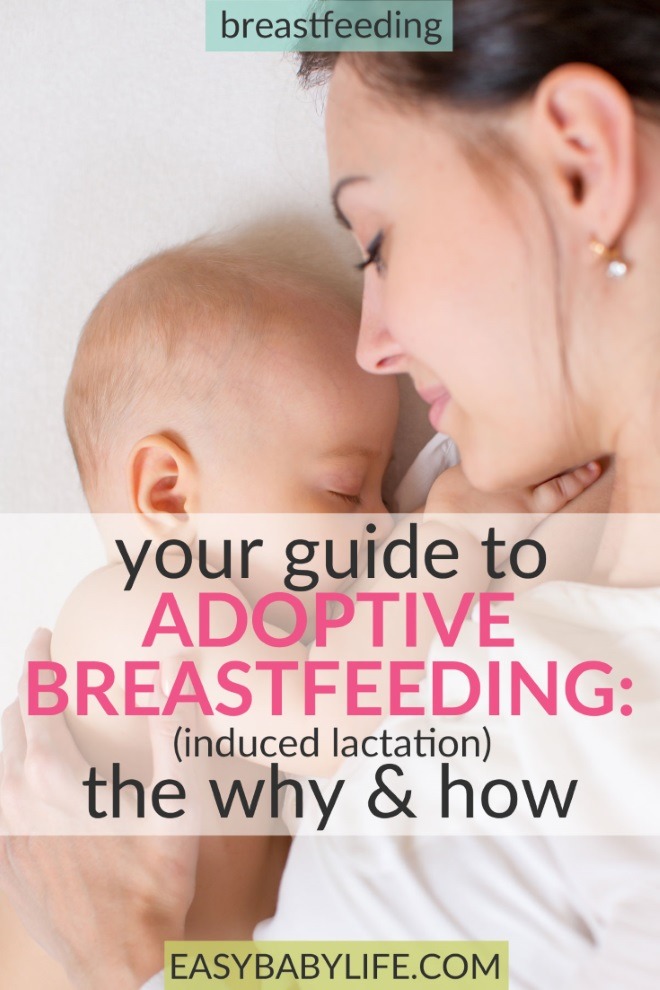
Adoptive breastfeeding refers to the practice of an adoptive mother nursing a child who she is parenting due to adoption. To make it possible, something called induced lactation is used.
Contrary to what many people believe, it is not necessary to have been pregnant in order to breastfeed.
The practice of breastfeeding an adopted baby is gaining steam and is becoming more known in the western world. Actually, it wasn’t until 2005 that the American Academy of Pediatrics started recommending that pediatricians should “counsel adoptive mothers on the benefits of induced lactation through hormonal therapy or mechanical stimulation”.
On the other hand, in many traditional cultures this has been a common and uncontroversial procedure for a long time, providing many benefits both for the baby and mom.
Adoptive Breastfeeding 101
- What Is Adoptive Breastfeeding?
- Why Breastfeed An Adopted Baby?
- How To Induce Lactation
- How To Teach A Baby To Latch?
- Book Tips
What Is Adoptive Breastfeeding?
I nduced lactation is the act of using means such as pumps, herbs, medicines, and nursing to encourage the hormones and the production of the adoptive mother’s natural milk.
As you know, pregnancy is what normally triggers the production of breast milk, so it takes a bit of effort and help to get milk production going in other ways. This is why it is called induced lactation.
Again, women do this so that they can create a biological means of nursing their adoptive babies.
Why Breastfeed An Adopted Baby?
There are many good reasons for adoptive mothers to breastfeed their baby.
To start with, there is a long list of health-related benefits of breastfeeding, which you can read about here. And many of these benefits continue to be valid even if the baby is a few months old when the breastfeeding starts.
In addition, breastfeeding might facilitate the bonding process between the mom and adopted the baby. An important point is that many adopted children have experiences prior to the adoption that leave them emotionally vulnerable. Studies have then shown that breastfeeding has helped these children heal.
For some mothers, it may also be positive to not lose the breastfeeding experience (in addition to pregnancy and birth).
How To Induce Lactation
The adoptive mother can use a variety of means to induce milk production. One method is to simply let the baby suckle. The stimulation caused by the suckling will increase prolactin levels and hence induce milk production.
However, this isn’t of much help for women who want to induce milk production before the baby arrives. In such case, using a milk pump to induce lactation is an effective method. The recommendation is to pump six times a day for at least 10 minutes on each breast, using a high-quality, electrical hospital grade breast pump, like this one (Amazon).
Cheaper, light-weight pumps will not be effective enough. If you don’t want to buy such an expensive pump, consider renting one. (If you are confused over the many different types of breast pumps, you can read about them here.)
Herbs such as Fenugreek, Red Raspberry Leaf, Fennel, and Mother’s Milk Tea all work to increase the hormone levels that produce milk naturally. These herbs mimic synthetic hormones.
It is also possible to use a variety of hormones, such as Oxytocin, Prolactin, Estrogen, and Progesterone. All of these hormones also come with risk and must be monitored carefully. The use of hormones to induce lactation is not uncontroversial.
Yet another option is to use special drugs that increase supply (metoclopramide) Domperidone, although this is also debated. It is not necessary for you to use in order to breastfeed an adopted baby, but it will help you develop a more abundant milk supply faster. However, no drug is 100% safe, so don’t use it without consulting a lactation clinic first.
In addition, breast massage and nipple stimulation might help, as well as eating healthy and drinking a lot of water.
Either way, the best you can do is to contact a specialized lactation clinic to start getting your milk supply ready as soon as your baby is in sight.
How To Teach A Baby To Latch?
Even a newborn baby that has never been bottle-fed needs time to learn how to latch properly. A baby used to bottle feeding may have even more problems, because the suckling techniques are completely different. But babies are fantastic at learning!
You need patience, but most likely, your baby will learn how to latch. In general, it is easier to teach a baby younger than 4 months old to latch, but it is entirely possible with older too.
While trying to teach your baby to latch, a few tips might come in handy:
- If this is the first time you breastfeed, or if it has been a while since the last time, make sure you contact a lactation consultant to help you out. They are a wonderful resource to get the breastfeeding work optimally
- When starting to breastfeed, sit up in a comfortable position. You can use a nursing pillow to support your arm and baby
- Start trying to nurse when your baby is alert, awake and hungry, but not starving.
- Don’t make the nursing into a power-struggle! If your baby doesn’t want the breast, don’t try for more than 10 minutes at the time. The risk is otherwise that both of you will just become irritated, which will be an effective way to make your baby refuse the breast even more.
- Skin to skin contact might make your baby calmer.
- Turn your baby on her side, facing you tummy to tummy. Her mouth should be right in front of your nipple.
- Squeeze a drop of milk to moisten your nipple.
- Use your hand to steer the nipple towards your baby’s mouth. If you tickle her lower lip a bit, she is likely to open her mouth wide.
- As the mouth opens to its widest point, direct your nipple into the center and use your arm behind to pull baby in very close to you. Be quick, but use soft movements – you only have a second, before the mouth may be closed again. Remember to move your baby, not yourself be leaning forward, because that will only put strain on your back.
- Since your milk production may not be that great, especially not in the beginning, consider using a lactation aid. With this, your baby will actually get milk or formula from a bottle while suckling. Hence she will get a reward (milk) from suckling and you will get the benefit from her suckling stimulating your milk production even more.
- Remember that your baby should suck the whole areola, not just the nipple. Otherwise, your nipples will be sore, and your child will also have a much harder time expressing the milk.
We have gathered a few video clips showing babies that latch more and less efficiently to give you a clue of what it should look and sound like. You can watch the baby latch-on videos here.
Book Tips For Adoptive Breastfeeding
Adoptive breastfeeding is wonderful, but no doubt can take a lot of time, effort, and commitment. If you want to learn more, here are a few good resources to dig through:
- Breastfeeding an Adopted Baby and Relactation (La Leche League International Book)
- The Breastfeeding Mother’s Guide to Making More Milk
- The Ultimate Breastfeeding Book of Answers: The Most Comprehensive Problem-Solving Guide to Breastfeeding from the Foremost Expert in North America
Related Content For Adoptive Breastfeeding
- The amazing benefits of breast milk
- Extended breastfeeding (for toddlers) – how and why
- Breast Milk Donation and Breast Milk Banks: Why, How, Risks, and Benefits
References on Adoptive Breastfeeding
Gribble, K.D. Mental health, attachment and breastfeeding: implications for adopted children and their mothers. Int Breastfeed J 1, 5 (2006) doi:10.1186/1746-4358-1-5
Anisfeld, E. et al. Does infant carrying promote attachment? An experimental study of the effects of increased physical contact on the development of attachment. Child Dev 1990; 61:1617-27.
Bowlby, J. Attachment and Loss, Vol 1: Attachment. London, England: Hogarth Press, 1969.
Daly, S.E. et al. Frequency and degree of milk removal and the short-term control of human milk synthesis. Exp Physiol 1996; 81: 861-75.
Drury-Hudson, J. Some effects of attachment disturbance on child behaviour. Children Australia 1994; 19:17-22.
Gribble, K. Mother comfort: The breastfeeding of older adopted children. International Lactation Consultants Association Conference 1-3 August, 2003, Sydney, Australia.
Gribble, K. The influence of context on the success of adoptive breastfeeding: Developing countries and the west. Breastfeed Rev 2004; 5-13.

Paula Dennholt founded Easy Baby Life in 2006 and has been a passionate parenting and pregnancy writer since then. Her parenting approach and writing are based on studies in cognitive-behavioral models and therapy for children and her experience as a mother and stepmother. Life as a parent has convinced her of how crucial it is to put relationships before rules. She strongly believes in positive parenting and a science-based approach.
Paula cooperates with a team of pediatricians who assist in reviewing and writing articles.