

You know the phrase “to sleep like a baby”, indicating to sleep deeply and peacefully.
A complete lie!
Any parent will tell you that sleeping like a baby is hard work! And taking care of someone who “sleeps like a baby”, is even worse. Welcome to parenthood! :-)
Knowing what to expect regarding your baby’s sleep pattern really helps!
Let’s take a look at young babies’ true sleep pattern
- They spend 50% of their sleep in active Rapid Eye Movement (REM) sleep, which is relatively light and often filled with dreams. Adults spend some 20% of their sleep in REM sleep.
- Their sleep cycles are very short compared to adults.
- With short sleep cycles and lots of light sleep, babies tend to wake up often.
- When they wake up, they have generally no clue how to go back to sleep on their own.
- Add to this, tiny tummies and an enormous growth rate and it is easy to understand why some babies tend to wake up very often around the clock.
All this means lots of disrupted sleep both for the baby and for you. For the baby, this is natural (more or less), but for an adult – not so much.
BUT things do get better over time, as this post will show you. And it is not hopeless – you can impact how fast the situation will improve!
Is your baby’s sleep pattern similar to what it was when he or she was in your stomach?
When I was pregnant with my daughter, she was a very active baby. Already in pregnancy week 23, I woke up almost every night because she kicked me so hard. During the first 10 months of her life, she continued to wake up every second hour to feed almost every night.
I know science tells a different story, but with my babies the old wives’ tale is true. My youngest boy didn’t wake me up even once while in my womb – and he has always slept better at night than his sister did at the same age. I suppose some babies simply need more sleep help than others.
Was I tired during my daughter’s first year? No – exhausted! (But then I didn’t do much to teach my baby to sleep better, nor did I know how to improve my own sleep.) So who wants to sleep like a baby..? Not me!
In any case, it’s good to know a bit about how babies sleep in general. Their sleep pattern changes quite a bit during their first year.
Your Baby’s Sleep Pattern by Month During Their First Year
In this article…
Newborn Baby Sleep Pattern – Lots of Sleep, But Not on Their Own
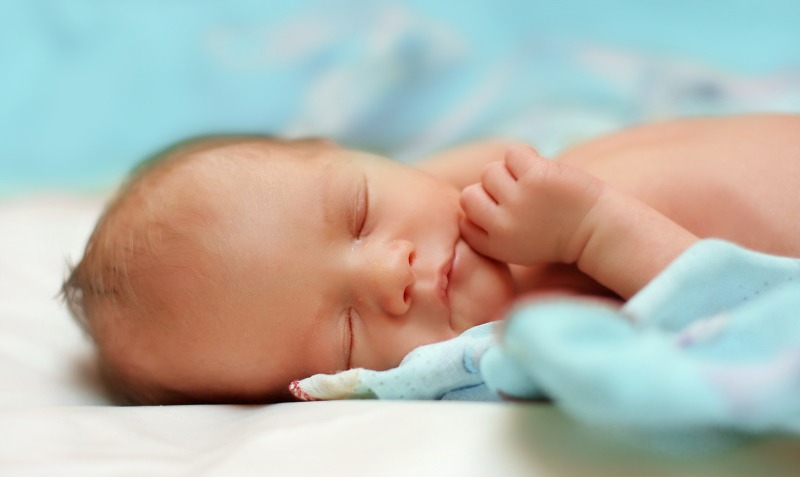
Newborn babies tend to sleep a lot, some as much as 20 hours a day. This usually does not mean, though, that Mom and Dad have a lot of spare time.
The baby’s sleep cycle, especially during its first month, is a lot shorter than an adult’s. Actually, babies have twice as many periods of light sleep as adults and thus have ample opportunities to wake up.
It is hard work to sleep like a baby! :-)
Also, there is absolutely no guarantee that the newborn’s longest period of unbroken sleep will occur at night.
Since newborn babies are used to falling back to sleep by being rocked in the warm water inside the womb, the baby might not at all be able to go to sleep on his or her own once born. So even if he or she sleeps most of the day, your baby might very well spend a lot of that time in your arms or at least with your help in some way.
A Swedish child expert, Anna Wahlgren, describes the 2-week-old baby as going through its second birth. Before that, most newborn babies really don’t do much more than sleep and eat. You might not even see them with their eyes open very often. After two weeks, the newborn baby’s sleep pattern starts to change as they slowly start to open up to the world outside the womb. At six weeks, many infants have started to sleep more at night than during the day.
But it might take longer. With my youngest boy, my impression is that he more or less just slept during his first 2.5 months – at least compared to his older sister.
Baby Sleep Pattern At 3 Months – Longer Sleep Cycles, But Still Wakes Up
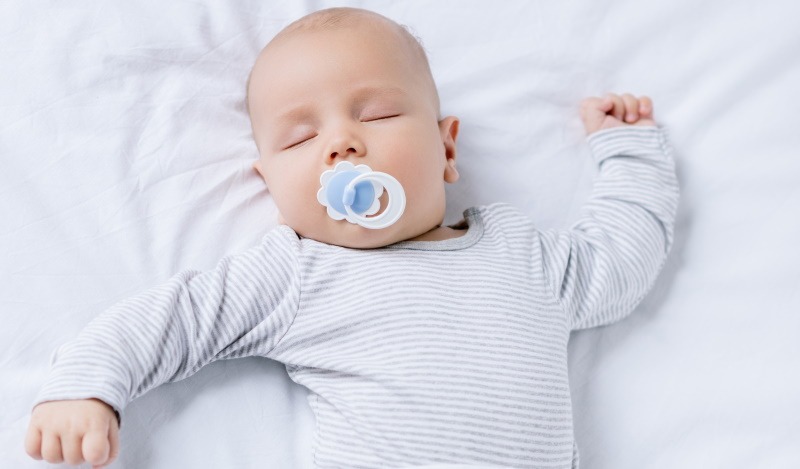
As your child grows older, your baby’s sleep pattern will become more similar to that of adults.
At the age of three months, babies sleep some 13-15 hours a day, and usually most of this at night. Still, this does not have to mean undisturbed sleep for you. Most babies wake up at least once or twice every night.
If your baby wakes up often and if you have the energy to think long-term, take some time to try making your baby go to sleep without feeding, by giving him or her a pacifier, rocking gently, or whatever you would do at daytime to make your child fall asleep. Chances are he or she is not at all hungry, but still needs some help.
If it’s been a tough night or day and you’re really tired – prioritize your own sleep. Feed your baby and head back to your bed. Or feed in your bed. Don’t play hero or supermom; make your life as easy as possible!
At some point around or after three months, you should be able to guide your baby towards three naps a day. One in the morning, one after lunch, and one in the afternoon. Try to keep the baby asleep for over an hour each time. If the baby has slept for over an hour, he should be able to stay awake for 1.5 to 2 hours before taking another nap. Life suddenly becomes more predictable!
This way, your baby will go to bed quite early in the evening at around, say, 8 or 9 pm and should, after a while, consider it to be night until around 7 am. Mmm, some grown-up time in the evening!
Baby Sleep At 6 Months And Up – Less Need to Feed at Night
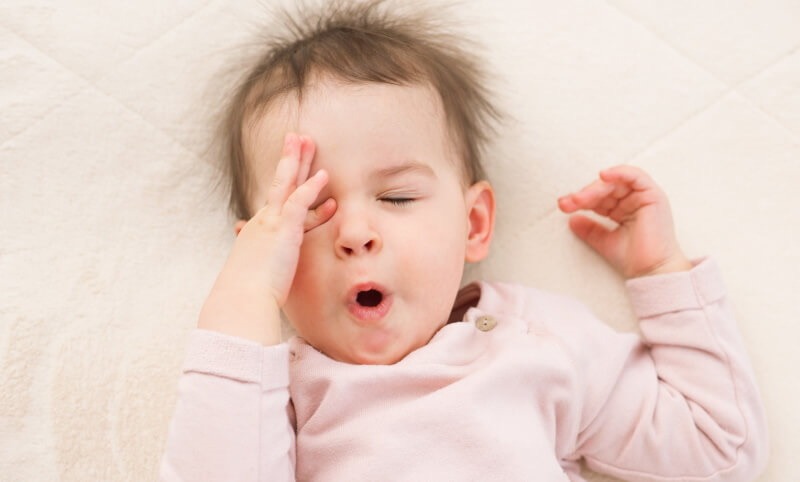 Between 6 and 12 months, babies’ daily sleep will gradually fall to 12 to 14 hours a day. According to my experience, your baby’s sleep pattern will remain at that amount of sleep for quite some time. By this time, if your child is healthy he doesn’t need to eat at night anymore. What he wants may, of course, be another story…
The number of naps is usually reduced from 3 to 2 at some point during the baby’s second half-year, one before lunch and one in the afternoon.
My babies’ healthcare provider means that babies heading for their first birthday should not sleep after 3 pm to help them be really tired in the evening. That did not work at all with my kids, but it hasn’t been super-important either. But I tried to make them fall asleep before 3 pm for their last nap.
Read Next
For more details around babies’ sleep schedules at different ages, click here.
And you’ll find a lot more baby sleep tips here.
Good luck and sweet dreams!
Please share any thoughts or experiences on your baby’s sleep pattern by leaving a comment below.
Research References
- The sleep pattern of normal children
- Development of infant and toddler sleep patterns: real-world data from a mobile application
- Normal sleep patterns in infants and children: a systematic review of observational studies.

Paula Dennholt founded Easy Baby Life in 2006 and has been a passionate parenting and pregnancy writer since then. Her parenting approach and writing are based on studies in cognitive-behavioral models and therapy for children and her experience as a mother and stepmother. Life as a parent has convinced her of how crucial it is to put relationships before rules. She strongly believes in positive parenting and a science-based approach.
Paula cooperates with a team of pediatricians who assist in reviewing and writing articles.




Hi Deniss!
I read the article you linked to. It is the cry-it-out method. How we handle our children’s sleep is ultimately every parent’s choice. I personally don’t like the methods taught in the article.
It says that babies don’t know how to sleep. Of course, they do – they’ve slept a lot in the womb! What they can’t is to sleep all alone far away from their parents. And you can definitely argue when is the appropriate time to learn that skill. Even adults usually prefer to sleep next to the one they love. ;-)
And teaching the baby to sleep alone by NOT attending to them when they call for you, is simply not a method I agree with. Babies use crying as a way to communicate how they feel, not to annoy us or challenge our rules.
It also says to maintain the routine no matter what. Babies change a lot during the first few years. So do their sleep habits. While babies certainly are routine lovers, we as parents need to adapt the routines all the time to adjust to our growing children.
So, for an honest answer, the methods in the article is not my preference. I believe much more in slow baby steps to teach a baby sleep alone, if that’s what you want, bed or bedroom sharing, et cetera. But again, every parent needs to decide what’s best in their family.
Hi Paula, I love what you say here. My baby has always been an excellent sleeper as I organised her life according to her needs – when she wanted food she ate, when she wanted sleep/was tired then she was put to bed. Our sleep routine was about 7 seconds long and usually she would be asleep by the time I left the room. If I had to be with her for more than 2 minutes as she was unsettled then it was extremely unusual. I was pushed by my husband and mother to try the cry it out method as my baby got older and sometimes changed her sleep habits and didn’t always fall asleep immediately as she had usually done or woke up mid nap and didn’t immediately soothe herself to go back to sleep. Almost always when this happened it was the case that she was getting an ear infection or other illness such as cold and so who could really blame the baby for being unsettled when she was on the way to being ill? The CIO method did not work – it just made her hysterical and so upset that sleep was never going to happen. A snuggle and some love and she would go back to sleep almost every time. I always would think of it like us as adults = do we sleep on demand??? Do we always sleep easily in unfamiliar places??? Do we always sleep through the night without waking up??? Do we prefer to have someone to snuggle with in bed to help us to go back to sleep during the night??? Pretty much Yes to all. So why would I expect other from my baby was my thinking. So generally my baby is a perfect sleeper in that she 98% of the time goes to bed when I put her in and goes to sleep immediately Sometimes she will play a little with her cuddly toys for about 15 minutes before settling to sleep – but that’s what we do also as adults reading our books/playing on our phones in bed before turning the light off to sleep. It is what you say – each parent must decide what works for them and their child – but over all I think that a secure and loved child with their needs being met will usually sleep well. Incidentally our baby also never felt the need for a pacifier or other such soother. But maybe we just got lucky…
nice blog..:)