
Caring for the newborn baby’s umbilical cord stump is one of the scariest things for new parents.
“Is it supposed to look like that?” “Smell like that?!”
Learn here what to keep in mind when caring for your newborn’s umbilical cord stump.

Tips For Umbilical Cord Stump Care
- Umbilical Cord Facts
- When It Will Fall Off
- How To Care For It
- Signs Of Infection
- When to Call A Doctor
Umbilical Cord Facts
The umbilical cord is the baby’s connection to the placenta. In the womb, the placenta provides essential nutrients and oxygen to the baby. The cord is no longer needed once the baby has been delivered.
At birth, the cord is clamped to prevent bleeding and cut. Because there are no pain-causing nerves in the umbilical cord, this does not hurt your baby at all. The result is the stump that you now see.
When It Will Fall Off
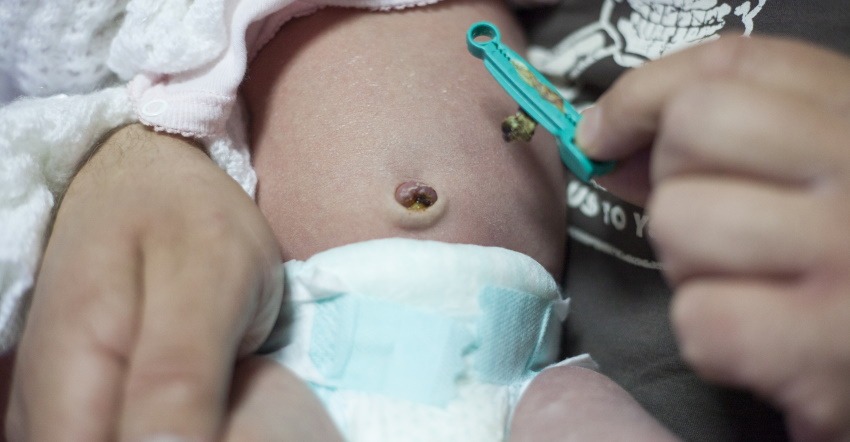
Every newborn is different. Some cord stumps fall off within days of delivery. Others can take up to three weeks to fall off.
The average time that the cord will dry up and fall off is 10 to 15 days.
Be sure that you do not pull on it, even if it looks like it’s only hanging on by a thread. Pulling it off can cause bleeding.
How to Care For the Umbilical Cord Stump
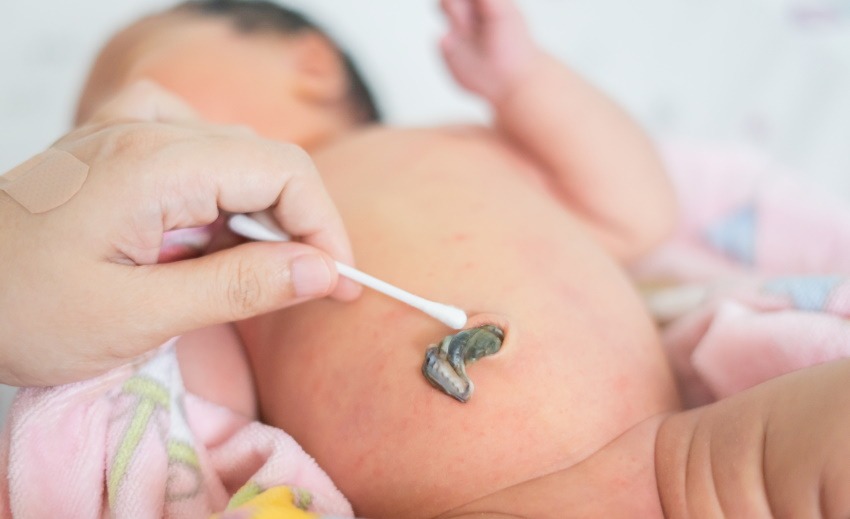
Here are some useful tips on how to care for the umbilical stump:
Keep it Dry and Clean
Keep the area around the base of the stump clean and dry. If you need to clean the area around the cord stump, use a sponge or a cotton swab.
Some doctors may still recommend swabbing the stump with rubbing alcohol two or three times a day to speed the drying process and keep away any odor.
Many experts, however now promote allowing the stump to dry on its own. A study by Hamilton Health Sciences Corporation in Ontario, Canada already in 1998 found that stumps that were left to dry on their own actually fell off two days faster than those rubbed with alcohol. And not even one of the 1800 newborn babies in the study developed an infection, alcohol or not.
Only Sponge Baths Until It Falls Off
Avoid giving tub baths until after the stump falls off. Until that time, you can give your baby sponge baths.
Air Exposition
Make sure to allow adequate air circulation by dressing your baby in loose-fitting clothing during this time. It is also important to fold down the front of your baby’s diaper or use newborn diapers with a cutout for the umbilical cord. This keeps urine away from the site and prevents infection.
Don’t be scared if you find a little bit of blood on your baby’s diaper or clothes, a little bit of bleeding is normal.
Caring for your baby’s umbilical cord stump really is easy as long as there is no infection. Check out this 1-minute video below. This is literally all you have to do!

Signs Of Infection
Umbilical cord infections are not common, but it is good to know the signs just in case.
If your baby develops a fever it may be the sign of an infection of the cord stump. Other signs of infection include a red or swollen area around the base of the stump, yellow or white pus, a foul odor, or if it seems like the area is painful.
Please note though, that being a little red is however usually not a sign of infection, and as you will notice, right before the stump actually falls off, it smells!! (And that is completely normal.) At least if you don’t wash it off with alcohol.
When to Call A Doctor

It is important to call your baby’s doctor if you suspect that your baby is developing an infection. Also, call your pediatrician if you have any questions about caring for your baby in general or about caring for the cord stump. Your baby’s doctor will be happy to answer your questions and offer advice.
Caring for the cord stump doesn’t have to be scary or complicated. As long as you keep it clean and dry, and watch out for signs of infection, you should be fine. Before you know it, the stump will have fallen off and all that will be left is an adorable little belly button.
And after it falls off, if the belly button does not look completely adorable immediately, don’t worry. It most likely will soon!
It can look a bit raw and red at first, but within a couple of days or even up to a week or more it will start looking like the cute belly button it is about to become. There may be occasions when the belly button won’t close properly. You can read more about that here.
Finally, if the umbilical cord stump hasn’t fallen off after three weeks, the recommendation is to contact your baby’s health care provider.
You’ll find more useful articles on newborn care here.

Paula Dennholt founded Easy Baby Life in 2006 and has been a passionate parenting and pregnancy writer since then. Her parenting approach and writing are based on studies in cognitive-behavioral models and therapy for children and her experience as a mother and stepmother. Life as a parent has convinced her of how crucial it is to put relationships before rules. She strongly believes in positive parenting and a science-based approach.
Paula cooperates with a team of pediatricians who assist in reviewing and writing articles.