
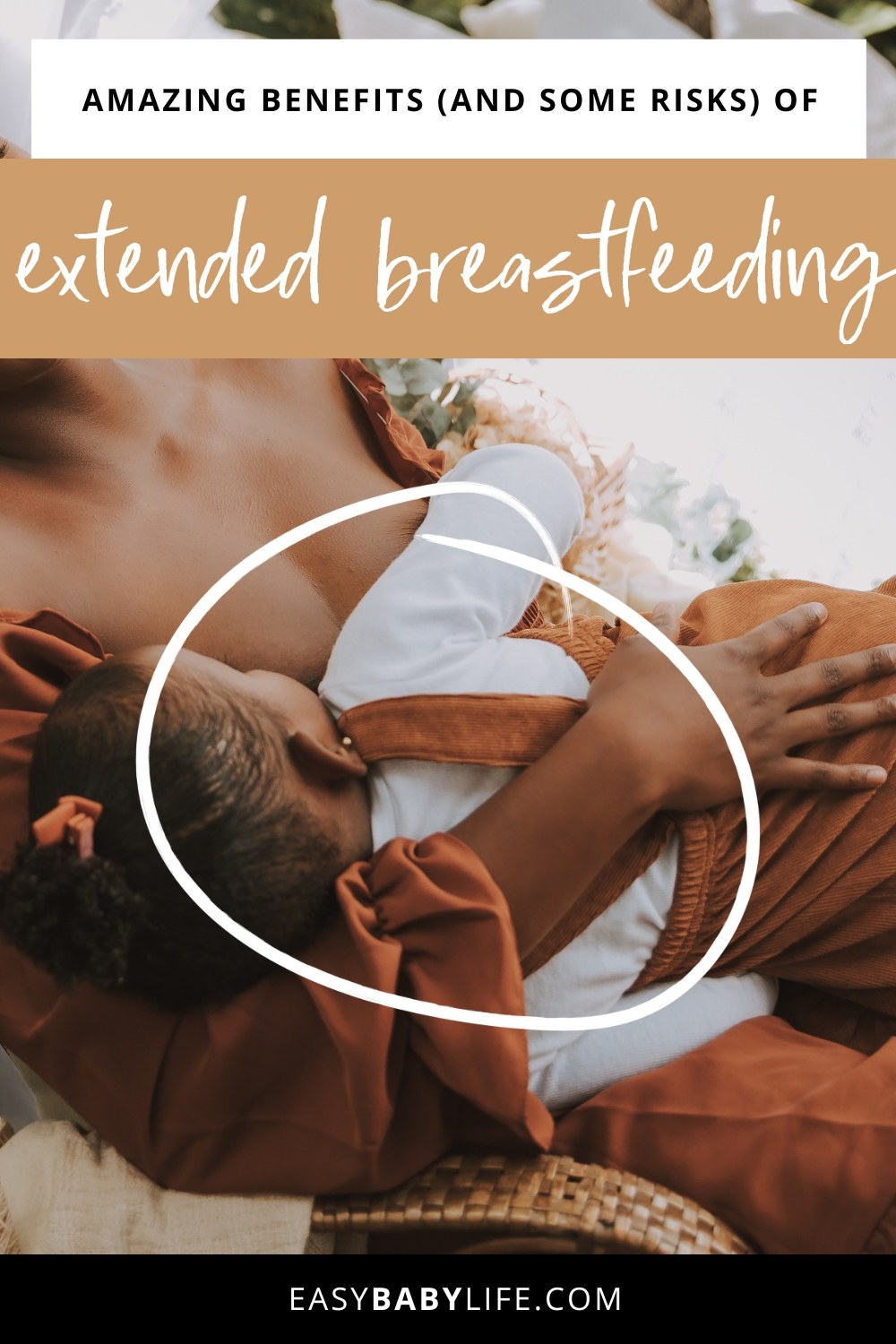
While breastfeeding generally has many benefits, an increasing number of research studies also find benefits related explicitly to prolonged or extended breastfeeding, both for the baby and the mom. There are also a few risks, but nowhere near as many or as significant as the positive effects.
Here, we dig into what science says about the pros and cons of extended breastfeeding.

The Definition of “Extended”
If you haven’t heard or thought much about the term “extended breastfeeding” before, you may wonder what we are actually talking about. Extended how? And beyond what?
These are good and relevant questions; the answer depends on who you ask. In the United States and many other Western countries today, it is considered normal and a great thing if a mom breastfeeds her baby for up to one year of age and then wean the child. After that, it starts to slowly become more controversial, and the mom is also said to be doing extended breastfeeding.
In many other parts of the world, breastfeeding a one-year-old or older child is simply to breastfeed—no need for fancy terms. Breastfeeding in some parts of the world continues until a child is 2, 3, or sometimes four years of age.
Simply put, extended breastfeeding means breastfeeding a toddler (i.e., older than one year).
One can, of course, question why anyone outside a baby’s immediate family would care at all for how long a baby is breastfed. It is not like the mom is feeding her baby wine – breast milk is very healthy; at least, that should be something we can all agree on!
However, discussing this cultural stigma is not the article’s purpose (even if it is undoubtedly important). Instead, I want to share with you the benefits of extended breastfeeding, as well as the risks (yes, they do exist).
A growing body of research is finding new health benefits of breastfeeding beyond the first year of life. Exciting, indeed! (You can find links to all the research studies below the article.)
Extended Breastfeeding Benefits For The Child

Nutrition
Breastmilk contains protein, fat, and other nutritionally essential elements no matter how long you breastfeed or how old your child is. Therefore, it is not true that breastmilk loses its nutritional quality after a certain period of breastfeeding. Beyond the first year, it can still provide a significant portion of a child’s daily requirements for many essential nutrients, such as vitamins A and B12.
In one longitudinal study that focused on the composition of human milk in the second year postpartum, participants who were still breastfeeding or expressing milk at least three to four times a day provided milk samples from 11 to 17 months postpartum. The results showed that concentrations of total protein, lactoferrin, lysozyme, IgA, sodium, and oligosaccharides increased over time while zinc and calcium concentrations decreased. There was no observed change in lactose concentration.
Overall, the study’s findings suggest that the macronutrient value of human milk is stable or increasing during the second year postpartum.
Boosted Immunity
Breast milk has many properties that protect against certain infections. For example, the milk contains antibodies to microbes the mom has been exposed to, antibacterial and antiviral agents like lactoferrin, lysozyme, and fatty acids.
Also, breastfed babies have more healthy gut bacteria than formula-fed babies.
According to research, babies that continue to breastfeed beyond one year seem to benefit from these immune-boosting properties at least until 18 months of age, as breastfed babies have fewer infections and colds than babies who do not breastfeed or are completely weaned earlier.
According to some sources, some immune factors found in breastmilk that protect the baby against infections are present in greater amounts in the child’s second year of life than in the first.
Protection against Crohn’s disease and Ulcerative colitis
Studies indicate a sharply reduced risk (80% lower) of Crohn’s disease and ulcerative colitis when breastfeeding for 12 months or more compared to only breastfeeding for 3-6 months.
Reduced risk of Type 1 Diabetes
Type 1 Diabetes risk may decrease by as much as 50% if breastfeeding for at least 12 months compared to not breastfeeding at all.
Improved Cognitive Development
Extended breastfeeding has been linked to improved cognitive outcomes, possibly due to the presence of specific fatty acids in breast milk that are vital for brain development. A Brazilian study of almost 4,000 children found that babies who breastfed for 12 months or more had higher IQ scores, a longer education, and higher monthly incomes at 30 years of age than those who breastfed for less than one month.
Reduced risk of misaligned teeth
The natural sucking action required during breastfeeding may promote a reduce the risk of malocclusions (misaligned teeth). This contrasts bottle feeding, which can sometimes lead to dental issues if certain habits, like prolonged bottle use, are continued beyond infancy. The same goes for pacifier use.
Several studies have concluded this link between breastfeeding and teeth alignment. A study from 2018 looked at extended breastfeeding and found that breastfeeding for 12 months or longer was associated with lower odds of overjet, open bite, and posterior crossbite.
Emotional and Psychological Benefits
Breastfeeding is often a source of comfort and security for toddlers. The closeness and physical touch during breastfeeding can help toddlers navigate stressful events and foster a stronger emotional connection between the mother and child. Some studies also indicate a positive correlation between breastfeeding duration and the bond between the mother and child that is still measurable when the child has become a teenager.
Benefits for the Mom

Breastfeeding lowers the risks and protects the mother from certain diseases, both while breastfeeding and sometimes in a longer-term perspective.
Breast Cancer Reduction
Prolonged and extended breastfeeding is associated with a reduced risk of breast cancer. According to the collaborative reanalysis study, for every 12 months of breastfeeding (either with a single child or combined across multiple children), the risk of breast cancer is reduced by about 4.3%. This may be due to breast tissue changes or decreased lifetime exposure to certain hormones related to cancer. Another study found a 26% lower risk of breast cancer among moms who breastfed for at least 12 months than those who didn’t breastfeed.
Ovarian Cancer Reduction
The exact mechanism isn’t fully understood, but it’s believed that the reduced ovulation that often occurs with prolonged breastfeeding could be a factor. Less ovulation means fewer chances for cell mutation during the egg-releasing process, which might contribute to reduced cancer risk. One study found that breastfeeding >12 months is associated with a 37% reduced risk of ovarian cancer.
Reduced Risk of Diabetes mellitus
Extended breastfeeding may reduce the risk of diabetes mellitus (type 2) by as much as 30% compared to breastfeeding for a shorter period.
Rameez RM, Sadana D ,Kaur S, et al. Association of maternal lactation with diabetes and hypertension: a systematic review and meta-analysis JAMA Netw Open 2019;2(10):e1913401
Reduced risk of Hypertension
Hypertension risk (i.e., the risk of high blood pressure) is also reduced by breastfeeding for more than 12 months. The risk then falls by 12-13%.
Lower risk of rheumatoid arthritis
Yet another possible benefit of extended breastfeeding relates to rheumatoid arthritis (RA). Research has shown that women who breastfed their children were around half as likely to have RA compared to those who have never breastfed. Furthermore, the risk of RA decreased with increasing breastfeeding duration. This is in line with an earlier Swedish study that found women who breastfed for at least 13 months to have a 50% lower risk of RA than those who didn’t breastfeed.
Reduced risk of cardiovascular disease
Women who breastfeed for 12 months or longer during life seem to be less likely to develop cardiovascular disease than those who don’t breastfeed.
Cognitive benefits after the age of 50
A recent study found that found that longer time spent breastfeeding is associated with better cognitive performance later in life. Taking into account all the time the women had spent breastfeeding in life, they found that those who had not breastfed at all scored significantly lower in three out of four tested cognitive areas (learning, delayed recall, executive functioning, and processing speed) compared to women who had breastfed for 1-12 months. The results were even stronger when comparing no breastfeeding with extended breastfeeding; those not breastfeeding had lower scores in all four tested areas in this case. Overall, women who had breastfed the longest had the highest cognitive test scores.
Emotional Health
The close bond formed during breastfeeding can release hormones like oxytocin, which promote maternal feelings of love and attachment. Additionally, breastfeeding might reduce the risk of postpartum depression, also during prolonged periods, although the relationship is complex, and other factors also play a role.
More tuned in Parenting
There are also studies that show that the longer a mom breastfeeds, the more in tune with her baby’s needs she becomes, above and beyond family and maternal background characteristics. Additionally, the benefits of breastfeeding on maternal sensitivity extend beyond just the infant or toddler years. Moms who breastfeed for extended periods seem to naturally become more attuned to their child’s needs, implying that breastfeeding could initiate a series of advantageous effects on her parenting behaviors.
Drawbacks and Risks for the Child

Extended breastfeeding, while offering many benefits, also has some potential risks and disadvantages. In an earlier version of its position statement, the American Academy of Pediatrics (AAP) stated that “there is no evidence that breastfeeding into the third year of life or longer leads to psychological or developmental harm for the baby.” In the revised position paper, this sentence is not included, but AAP still supports extended breastfeeding up to 2 years of age and primarily emphasizes the positive related health effects for the breastfeeding mom. While the confirmed benefits of extended breastfeeding are substantial and abundant, there are a few negative aspects to consider for both the toddler and the mom.
Nutritional Imbalances
If breast milk remains the primary source of nutrition well into toddlerhood without adequate complementary foods, there’s a potential risk for nutritional imbalances. Children may miss out on iron, zinc, and other essential nutrients. It is important to note that extended breastfeeding doesn’t mean that a toddler should be exclusively or predominately breastfed, as this may cause deficiencies. Exclusive breastfeeding is recommended for the first six months, after which a child should be gradually introduced to a variety of nutritious foods to get enough of all the nutrients their body needs to achieve optimal health and growth.
If your toddler is eating nutritious, healthy, and balanced meals, including iron-rich foods, alongside breastfeeding, prolonged breastfeeding won’t increase the likelihood of iron deficiency.
Dental Caries
Dental caries (tooth decay) are possible if a child frequently breastfeeds at night after tooth eruption, especially without dental hygiene practices. It’s essential to maintain oral hygiene in breastfed toddlers.
Drawbacks and Risks for the Mother

Breast Health
While breastfeeding, there is an increased risk of developing mastitis, breast abscesses, or other infections if there are latch issues or the breast isn’t emptied regularly. This risk is more pronounced at the beginning of breastfeeding but continues until the baby is fully weaned.
Bone Health short- and long-term
While lactating, there’s a temporary decrease in bone mineral density in the mother. The density usually rebounds after weaning, but the interim decline can concern some women, especially those at risk for osteoporosis. In addition, relatively new research has found a negative correlation between the duration of breastfeeding and bone density after menopause. Extended breastfeeding may thus increase the risk of osteoporosis both in a short-term and long-term perspective.
Fertility and Contraception
Extended breastfeeding can delay the return of fertility, which might be a disadvantage for mothers wanting to conceive again. It also makes natural family planning methods less predictable. It should, however, be noted that although breastfeeding may impact fertility, it is a myth that it is impossible to get pregnant while breastfeeding. Several factors, such as maternal age and the duration and frequency of breastfeeding, influence the return of the period after delivery.
Changes in breastfeeding patterns often result in period return. Therefore, for many women, the ability to get pregnant again returns when they no longer breastfeed exclusively or when their baby starts to sleep longer during the night.
Once the baby starts eating solid foods, the frequency of breastfeeding and the milk supply will likely decrease, increasing fertility hormones and the likelihood of ovulation and pregnancy. Some mothers will notice that their period returned when their babies started sleeping longer stretches at night. In those cases, even that small change in breastfeeding frequency was enough to reduce the effect of breastfeeding on estrogen levels.
However, as mentioned, it is hard to say exactly when the period will return as this is very different for every woman.
Physical and Emotional Toll
Extended breastfeeding can be physically demanding. Mothers may experience fatigue, particularly if nighttime feedings continue. There’s also the emotional aspect: societal pressure, criticism, or the need for personal space can influence a mother’s feelings.
Social Stigma and Public Criticism
Public criticism can be a challenge mothers face when deciding that extended nursing is right for their children and themselves. You may receive odd looks, rude comments, and even outright criticism from family members, friends, and complete strangers who believe early weaning is best for a child. This can be tough to handle and result in feelings of isolation and being judged.
All this said, breastfeeding will always be a personal choice.
So, how long should you breastfeed?
There are cases where infant formula companies and even some doctors have encouraged mothers to stop breastfeeding at six months to a year, telling them breastfeeding past this point has no real benefits for your child. As seen in this article, they are wrong.
The American Academy of Pediatrics recommends exclusive breastfeeding for the first six months and continued breastfeeding until the baby is at least a year old with the addition of nutritious complementary foods. They also emphasize continued benefits from breastfeeding for the mother when breastfeeding goes beyond one year and up to two years.
World Health Organization (WHO) also recommends exclusive breastfeeding for the first six months of life. After six months, solid foods should be introduced, but breastfeeding should continue for the next two years and beyond.
All this said, breastfeeding will always be a personal choice. Many benefits are achieved by breastfeeding for around four months.
Takeaway
Breastfeeding has many significant benefits for both the baby and mom and in many cases, these benefits start kicking in immediately or after only a few months of breastfeeding. In addition, research has found several benefits primarily related to a longer duration of breastfeeding, which has been the focus of this article. Some known benefits, such as maternal weight loss or a reduced risk of sudden infant death syndrome (SIDS) for the baby, are therefore not mentioned. These benefits do not require extended breastfeeding.
Extended breastfeeding also comes with some risks and disadvantages. These are important to understand and mitigate.
The main pros and cons of extended breastfeeding relate to reduced risks of several illnesses for both baby and mom, while at the same time leading to a risk of teeth misalignment for the child and bone density loss for the mom.
Moms, what are your views or experiences of breastfeeding a toddler? Do you do it? Why, why not? Let’s share our experiences, but no judgements, please!
Read Next
- Benefits of breastfeeding starting on day 1
- 3 Effective Ways to Stop Nursing Baby To Sleep (No CIO)
- Is it True that Sex While Breastfeeding Destroys the Milk?
Research references
- Tucker Z, O’Malley C. Mental Health Benefits of Breastfeeding: A Literature Review. Cureus. 2022 Sep 15;14(9):e29199. doi: 10.7759/cureus.29199. PMID: 36258949; PMCID: PMC9572809.
- Victora CG, Horta BL, Loret de Mola C, et al. Association between breastfeeding and intelligence, educational attainment, and income at 30 years of age: a prospective birth cohort study from Brazil. The Lancet Global Health. 2015;3(4):e199-e205.
- Frank, N.M., Lynch, K.F., Uusitalo, U. et al. The relationship between breastfeeding and reported respiratory and gastrointestinal infection rates in young children. BMC Pediatr 19, 339 (2019). https://doi.org/10.1186/s12887-019-1693-2
- Duijts L, Jaddoe VWV, Hofman A, Moll HA. Prolonged and Exclusive Breastfeeding Reduces the Risk of Infectious Diseases in Infancy. Pediatrics. 2010;126(1):e18-e25.
- Thomaz EBAF, Alves CMC, Gomes E Silva LF, Ribeiro de Almeida CCC, Soares de Britto E Alves MTS, Hilgert JB, Wendland EM. Breastfeeding Versus Bottle Feeding on Malocclusion in Children: A Meta-Analysis Study. J Hum Lact. 2018 Nov;34(4):768-788. doi: 10.1177/0890334418755689. Epub 2018 Mar 29. PMID: 29596751.
- Fergusson DM, Woodward LJ. Breastfeeding and later psychosocial adjustment. Paediatr Perinat Epidemiol. 1999 Apr;13(2):144-57. doi: 10.1046/j.1365-3016.1999.00167.x. PMID: 10214606.
- Katja Linde, Franziska Lehnig, Michaela Nagl, Anette Kersting, The association between breastfeeding and attachment: A systematic review, Midwifery, Volume 81, 2020, 102592, ISSN 0266-6138,
- Oxford University Press (OUP). “Breastfeeding associated with lower risk of rheumatoid arthritis, according to new study.” ScienceDaily. ScienceDaily, 7 January 2014.
- Lena Tschiderer, Lisa Seekircher, Setor K. Kunutsor, Sanne A. E. Peters, Linda M. O’Keeffe, Peter Willeit. Breastfeeding Is Associated With a Reduced Maternal Cardiovascular Risk: Systematic Review and Meta‐Analysis Involving Data From 8 Studies and 1 192 700 Parous Women. Journal of the American Heart Association, 2022; DOI: 10.1161/JAHA.121.022746
- Molly Fox, Prabha Siddarth, Hanadi Ajam Oughli, Sarah A Nguyen, Michaela M Milillo, Yesenia Aguilar, Linda Ercoli, Helen Lavretsky, Women who breastfeed exhibit cognitive benefits after age 50, Evolution, Medicine, and Public Health, Volume 9, Issue 1, 2021, Pages 322–331,
- Joan Younger Meek, Lawrence Noble, Section on Breastfeeding; Policy Statement: Breastfeeding and the Use of Human Milk. Pediatrics July 2022; 150 (1): e2022057988. 10.1542/peds.2022-057988
- Dewey KG. The challenge of meeting nutrient needs of infants and young children during the period of complementary feeding: an evolutionary perspective. Journal of Nutrition. 2013;143(12):2050-2054.
- A.E. Burton, J. Taylor, A.L. Owen, J.E. Renshaw, L.R. Williams, S.E. Dean, A photo-elicitation exploration of UK mothers’ experiences of extended breastfeeding, Appetite, Volume 169, 2022, 105814, ISSN 0195-6663, https://doi.org/10.1016/j.appet.2021.105814.
- Brown A, Rance J, Bennett P. Understanding the relationship between breastfeeding and postnatal depression: the role of pain and physical difficulties. Journal of Advanced Nursing. 2016;72(2):273-282.
- Abanto J, Maruyama JM, Pinheiro E, Matijasevich A, Antunes JLF, Bönecker M, Cardoso MA; MINA-Brazil Study Group. Prolonged breastfeeding, sugar consumption, and dental caries at 2 years of age: A birth cohort study. Community Dent Oral Epidemiol. 2023 Jun;51(3):575-582. doi: 10.1111/cdoe.12813. Epub 2022 Nov 15. PMID: 36380436.
- Amir LH, Forster DA, McLachlan H, Lumley J. Incidence of breast abscess in lactating women: report from an Australian cohort. BJOG: An International Journal of Obstetrics & Gynaecology. 2004;111(12):1378-1381.
- Riordan JM, Nichols FH. A descriptive study of lactation mastitis in long-term breastfeeding women. J Hum Lact. 1990 Jun;6(2):53-8. doi: 10.1177/089033449000600213. PMID: 2346600.
- Hwang, I.R., Choi, Y.K., Lee, W.K. et al. Association between prolonged breastfeeding and bone mineral density and osteoporosis in postmenopausal women: KNHANES 2010-2011. Osteoporos Int 27, 257–265 (2016). https://doi.org/10.1007/s00198-015-3292-x
- Faircloth CR. “If they want to risk the health and well-being of their child, that’s up to them”: Long-term breastfeeding, risk, and maternal identity. Health, Risk & Society. 2013;15(6-7):580-597.

Paula Dennholt founded Easy Baby Life in 2006 and has been a passionate parenting and pregnancy writer since then. Her parenting approach and writing are based on studies in cognitive-behavioral models and therapy for children and her experience as a mother and stepmother. Life as a parent has convinced her of how crucial it is to put relationships before rules. She strongly believes in positive parenting and a science-based approach.
Paula cooperates with a team of pediatricians who assist in reviewing and writing articles.






This makes me so happy about my choice to continue nursing as long as possible! I have UC and it’s such a fear of mine that I will pass it on to my children. At least I now know this is one thing I can do to help lessen the risk! Thanks for this!
Hi Kim, I am sorry to hear about your ulcerative colitis, but I agree it is quite amazing how breastfeeding can help reduce the risk for your child. Thanks a lot for sharing!
xo
Thank you for this love the encouragement and positivity of why you can or should do this extended breastfeeding I’m a black mom and the criticism is even more so bc people just aren’t use to seeing it 18 months in exclusively breastfeeding ☺️
Thank you Shayla! Yes, standing up for what we believe is best for our children can be a struggle… especially when it goes against common beliefs and habits. Good luck and stay strong! :-)