Have you ever felt worried about your children’s eating habits? You are not alone! But before we start interfering, it can be good to know a bit about how children of all ages approach food if we don’t intervene – and what to do to promote sound eating habits in your little ones!

I’ve talked to several parents over the years who have felt the need to either force-feed their child or feed him or her while asleep. It may sound drastic, but if you are worried enough, you take drastic steps! Neither of these two steps will help resolve the situation, though.
Sometimes children have real problems with their eating habits that should be addressed with the help of specialists. But in general, we parents probably both worry and intervene way too much!
A very common example of this is when a child transfers from breastfeeding to formula or to eating solid baby foods. The minute mom can start controlling and measuring how much her baby eats, she starts to worry that the baby eating too much or too little. While breastfeeding, the amount consumed is much harder to control, and therefore, we tend to trust our babies’ hunger signals to a much larger extent – we literally have no choice!
Below you will learn what research has shown about children’s eating habits. Kids have some natural, very sound habits that we as adults should respect and not destroy because we tend to be control freaks when it comes to our babies! :-)You can also get a free printable with some golden rules to help you out here:
Children’s Eating Habits; What Research Says & What to Do
- How much do children eat?
- New foods
- What do children eat?
- When should children eat?
- The parents’ role in children’s eating habits
How much do children eat?
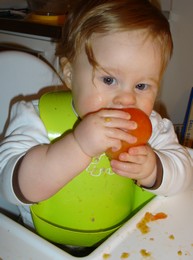 If we don’t interfere, our children will eat as much as they need. Being a very natural thing to do to survive, children want to eat and are fully capable of regulating their intake of food.
Think of it, even when newborn, babies stop eating when they are full. No matter how much you try, you won’t be able to force a full baby to eat. If you try, he or she will cry, spit, and turn the head away.
Why would not an 8-month-old or a 2-year-old be able to regulate his or her intake when he/she could do it already at birth?
Trust your baby!
It may also be good to know that children are inconsistent in their eating habits. One day they’ll eat a lot, the next day very little. One day your kid loves potatoes, the next day, he’ll refuse to even taste one piece.
That’s normal behavior for a child.
New foods
Children, as well as adults, learn to like foods that they eat often. Children are skeptical to new tastes and need time and experience to appreciate new foods.
Knowing this, remember to never force your child to try new tastes. Instead, encourage your child, and try to make the new foods interesting.
One way of doing this is to try it yourself. Many babies know very well from early on that they are served something completely different from what the rest of the family gets. Trying what is on your plate can be irresistible!
Our third kid was (and is) a very picky when it comes to trying new foods. But when I took small pieces of broccoli (which he usually hates) from my plate and gave to him, he was so excited and happy and ate all of them!
Research shows that children that often eat alone become pickier than kids that eat together with adults. So eat together!
Some fairly new research also indicates that babies’ food preferences may be, to some extent, determined already while fully breastfed because what mom eats will affect the taste of the breast milk. Read more here about the connection between mom’s diet and the taste of her breast milk.
What do children eat?
Your child will eat the food because it tastes good. This is obvious when feeding babies, but for quite old kids, telling them that they should eat, because the tomatoes are healthy or “good for you” simply won’t work. Children are not able to make that kind of choices until they are around 10 or 11 years old.
This is why it is so important that parents try to serve food that tastes good and is healthy!
When should children eat?
Children, especially young children, need and love routines. That goes for eating habits too. If you serve meals according to a relatively regular schedule, your child is likely to have a better appetite.
For example, if you wait for too long with serving dinner, your baby might be so tired that despite being hungry, he or she won’t eat.
The parents’ role in children’s eating habits
We count!
Parents can really help to give their children good eating habits. Or bad…
- If we pick on our babies, force them to eat, use fatty foods or sweets as praise or consolation and make our kids eat alone most of the time, we can really ruin their natural eating habits.
- On the other hand, if we eat together with our kids, serve them healthy food they like, combined with a few new foods now and then, and let the child decide how much to eat, their eating habits are likely to stay natural and develop well.
A notable American dietitian, Ellyn Satter, has some golden rules to avoid power struggles at the dinner table:
The parents’ responsibility is to:
- Choose and buy the food
- Plan, cook and serve the food
- Make sure the family meals are nice and friendly
- Decide what is acceptable manners around the dinner table
The children’s responsibility is to:
- Decide how much food he or she wants to eat
- If he or she wants to eat
For more ideas on how to avoid power struggles at the dinner table, read this post.
Research References
Ellyn Satter, Feeding dynamics: Helping children to eat well, Journal of Pediatric Health Care,Volume 9, Issue 4, 1995, https://doi.org/10.1016/S0891-5245(05)80033-1
Satter E. Eating competence: definition and evidence for the Satter Eating Competence model. J Nutr Educ Behav. 2007 Sep-Oct;39(5 Suppl):S142-53. doi: 10.1016/j.jneb.2007.01.006. PMID: 17826695.

Paula Dennholt founded Easy Baby Life in 2006 and has been a passionate parenting and pregnancy writer since then. Her parenting approach and writing are based on studies in cognitive-behavioral models and therapy for children and her experience as a mother and stepmother. Life as a parent has convinced her of how crucial it is to put relationships before rules. She strongly believes in positive parenting and a science-based approach.
Paula cooperates with a team of pediatricians who assist in reviewing and writing articles.