
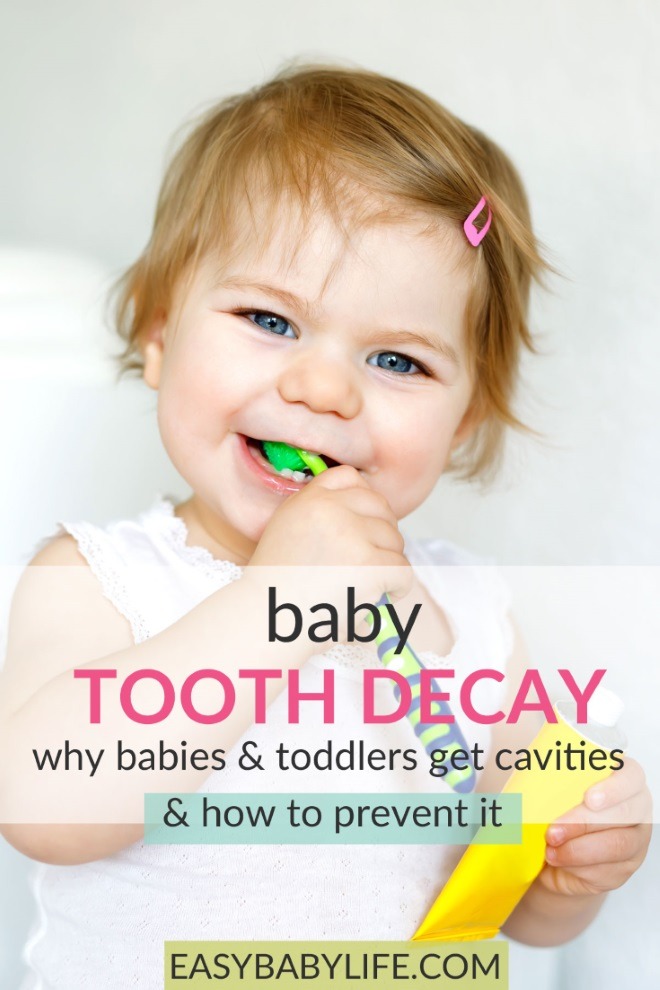
Baby tooth decay might not be the first thing you think about when your baby is teething.
Many babies and toddlers resist having a toothbrush shoved into their mouth, and hence it is very easy to make excuses to not have to take the battle. (Trust me!)
However, young children and even infants can develop dental caries or cavities when their teeth start to erupt.
Some people think that breast milk can cause cavities in babies. But, research shows that is not the case.
However, you need to look at the causes and reasons that actually lead to cavities and caries in babies to be able to take the right steps to prevent them.
Baby Tooth Decay Prevention
- Breast milk does not produce cavities
- Bottle feeding and formula milk
- Sweet foods and juices
- Advice for breastfeeding moms
- Preventing caries in infants and toddlers
Breast milk does not produce cavities
According to research carried out already in 1999 by P.R Erickson and E. Mazhari in “Investigation of the role of human breast milk in caries development,” laboratory tests reveal that human milk does not encourage cavities. This is due to the fact that mothers milk has immune factors which reduce the presence of unfriendly, cavity-causing bacteria in the baby’s mouth, preventing the teeth to decay.
However, infants and babies can develop dental health problems due to several reasons, so just because you are breastfeeding it doesn’t mean the baby is entirely safe. Supplementing with formula and later with solid foods still put your baby or toddler at risk.
Bottle feeding and formula milk
Formula is the major cause of “nursing caries” in babies and infants. Babies who are bottle fed have a higher chance of developing dental caries and decay. Baby tooth decay happens due to the presence of extra sugar, present in the form of lactose, in formula milk. This sugar acts as food for the bacteria present in the mouth, allowing it to grow and harm the baby’s gums and teeth.
Formula given to the baby especially at night causes the greatest damage as the baby may fall asleep while drinking milk. Once the baby is asleep, the flow of saliva stops, causing the lactose-rich milk to stay in the baby’s mouth for a longer period of time. To avoid this to happen, you should make sure that the baby is not fed immediately before sleeping so that the natural saliva production in the mouth after feeding helps clear the milk in the mouth.
Another reason for dental caries in bottle-fed milk is the habit of slow nursing in some babies. If babies are allowed to hold their bottle and drink from it slowly, and for a longer period of time, it allows the milk to stay in the mouth for a longer period of time, resulting in nursing caries. This problem is more common in babies who are allowed to bottle feed at an older age, including of course toddlers.
Sweet foods and juices
If a baby is introduced to very sweet foods such as juices or candies in their diet, it can lead to drastic dental problems. Frequent snacking throughout the day causes the teeth to be exposed to cavity-causing bacteria again and again.
Formula milk with lactose (i.e. sugar) also allows bacteria to grow in the mouth. Moreover, yeasts and bacteria may be present on the bottle nipple or pacifiers that are given to bottle feeding babies, which can promote cavity formation.
Therefore it is highly recommended that children over the age of 1 year should not be bottle-fed at all and that you try to limit pacifier use to a minimum. A tip is to start pulling out your baby’s pacifier right after falling asleep, to teach your child to sleep without the binky.
However, if you plan to use these bottles to provide your own milk to the baby, by pumping breast milk using a breast pump, “bottle-feeding” should be less of a problem.
Older children are of course also more likely to be given ice cream or candy. Try to minimize sugar content and be sure to brush your toddler’s teeth after and sweets.
Advice for breastfeeding moms
Breastfeeding moms can also develop “nursing caries”, especially if they are already prone to cavities. Teeth are like the bone in your body, and they require calcium to keep them strong. Nursing moms usually have lower levels of calcium in their body, no matter how many calcium supplements they take. This calcium only reaches its normal level once the mother stops breastfeeding.
Have you noticed how incredibly hungry one is while breastfeeding? Nursing moms often feel the urge to take snacks in between feeding their baby. If this snack is taken at night, and the teeth are not properly cleaned, the food sitting against the teeth can cause cavities in breastfeeding moms. Women prone to dental cavities should be extremely careful about their teeth during breastfeeding.
Preventing dental caries in infants and toddlers
 Many mothers breastfeed their baby for a year or more, but many also stop after 4 to 6 months, or earlier. And in any case, most babies will be introduced to solid foods at around 6 months, so the breastfeeding will be complemented with other food sources.
For babies that are not breastfed, but instead drink formula, the risk of baby tooth decay is higher.
Although cavities can be hereditary in children, you should make sure that your child’s dental health is optimized to prevent any cavities from developing.
Here are a few guidelines to prevent baby tooth decay:
- Try reducing the number of especially formula feeds during the night gradually.
- Sweet snacks or juices should be given during day time (or rather not at all) and should be completely avoided at night, so that the baby does not sleep with all the sweet in her mouth.
- After every snack or meal, you should allow the baby to clear the mouth, by giving water or by allowing the baby to swallow extra so that any remaining food particles or milk does not stay in the mouth.
As long as you ensure good dental hygiene, you can prevent your child from developing dental caries at a young age.
I hope this gave you some more insight on baby tooth decay! You can learn more about baby teeth care here.
More On Baby Teething & Teeth Care
- Common Baby Teething Symptoms – Myths Or True?
- Effective Teething Remedies For Your Baby
- Baby Teeth Care Tips
- No Teeth At 11 Months – Normal Or Not?
- Primary Teeth Development, Care, and Abnormalities to Check

Paula Dennholt founded Easy Baby Life in 2006 and has been a passionate parenting and pregnancy writer since then. Her parenting approach and writing are based on studies in cognitive-behavioral models and therapy for children and her experience as a mother and stepmother. Life as a parent has convinced her of how crucial it is to put relationships before rules. She strongly believes in positive parenting and a science-based approach.
Paula cooperates with a team of pediatricians who assist in reviewing and writing articles.